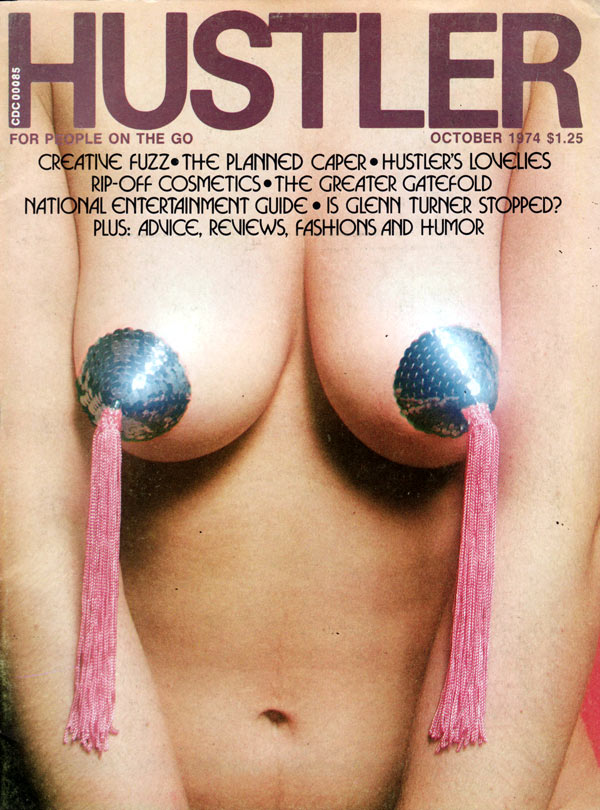
In March 1972, Larry Flynt created the Hustler Newsletter, a four-page, black-and-white publication of information about his Hustler clubs. This item became so popular with his customers that by May 1972 he expanded the Hustler Newsletter to 16 pages and in August 1973, to 32 pages.
As a result of the 1973 oil crisis the United States entered an economic recession; Hustler Club customers tightened their spending and Flynt had to find financing to pay his debts or go bankrupt. He decided to turn the Hustler Newsletter into a national sexually explicit magazine. He paid the start-up costs of the new magazine using sales taxes collected in the clubs. In July 1974, the
first issue of Hustler was published.
Although the
first few issues went largely unnoticed, within a year it became highly lucrative and he was able to pay his tax debts. In
November 1974, Hustler showed the first "pink-shots," or photos of open vaginas.
Flynt had to fight to publish each issue as many people, including his distribution company, found the magazine too sexually explicit and threatened to have it removed from the market. Shortly thereafter, Flynt was approached by a paparazzo who had taken nude pictures of former First Lady Jacqueline Kennedy Onassis while she was sunbathing on vacation in 1971. He purchased them for $18,000 and published them in the
August 1975 issue. That issue attracted widespread attention, and one million copies were sold within a few days. Now a millionaire, he bought a $375,000 (1976 dollars) mansion.
Hustler has long had a left-wing editorial policy on economics, foreign policy, and social issues. This distinguishes it somewhat from other pornographic magazines, which generally embrace progressive ideas about free speech and morality issues, but remain conservative, libertarian, or neutral on other matters such as the economy. Flynt and Hustler are also noted for having a more populist and working-class outlook than the more upscale-oriented Playboy and Penthouse. Throughout the 1980s, Flynt used his magazine as a podium with which to launch vitriolic, obscenity-laden attacks on the Reagan Administration and the Religious Right, and even published a short-lived political magazine called Rebel. During the controversy surrounding Bill Clinton's impeachment, Flynt publicly announced his sympathy for Clinton, and offered cash rewards to anyone with information regarding sexual impropriety on the part of the president's critics. In 2003, Flynt ran unsuccessfully for the office of Governor of California during that state's recall election.
Every month Hustler is mailed, uninvited and for free, to the office of each member of the United States Congress. This practice began at some point between 1974 and 1983, and it continues today. In an interview, Flynt explained, "I felt that they should be informed with what's going on in the rest of the world ... Some of them didn't appreciate it much. I haven't had any plans to quit."